
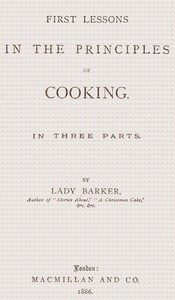
First lessons in the principles of cooking by Lady Barker
Let's be clear from the start: this is not a plot-driven novel. There's no dashing hero or hidden villain. The 'story' of this book is the story of teaching a fundamental life skill in the 1870s.
The Story
Lady Barker structures her book as a series of lessons, starting with the absolute basics. She assumes her reader knows nothing. We begin with how to manage a fire in a range, how to clean pots and pans (a serious chore), and how to choose good meat from the butcher. She then walks us through the core techniques of the time: boiling, roasting, baking, and broiling. The recipes that follow—for soups, joints of meat, puddings, and bread—are demonstrations of these principles. The narrative thread is her voice: patient, experienced, and occasionally exasperated by the common mistakes of novice cooks. It's the story of one woman trying to bring order, economy, and good taste to the Victorian kitchen.
Why You Should Read It
I loved this book for its sheer practicality and its glimpse into a different mindset. Lady Barker isn't just listing ingredients; she's teaching how to think about cooking. Her emphasis on economy and avoiding waste speaks volumes about the values of her class and era. You get wonderful little asides—why you shouldn't skimp on a good roasting jack, her opinions on different types of coal, the importance of a clean apron. It's these details that make the past feel real. Her tone is like a no-nonsense but kind aunt, which makes the historical distance collapse. You're not just reading about history; you're getting a scolding for letting your saucepans get black on the bottom!
Final Verdict
This book is a treat for a specific reader. It's perfect for history buffs and foodies who want to go beyond dates and battles and into the heart of daily life. If you enjoy shows about historical recreation or reading old diaries, you'll find a friend in Lady Barker. Modern cooks might find it humbling and hilarious (try guessing the temperature of a 'quick oven'). It's not a page-turner in the traditional sense, but it's a captivating slice of social history. Pick it up for a short, charming, and enlightening visit to a Victorian kitchen—just don't forget to blacklead the stove when you're done.
Legal analysis indicates this work is in the public domain. You can copy, modify, and distribute it freely.
Barbara Johnson
9 months agoAs a long-time follower of this subject matter, the transition between theoretical knowledge and practical application is seamless. I'm glad I chose this over the other alternatives.
Thomas Moore
2 years agoThis digital copy caught my eye due to its reputation, the author clearly has a deep mastery of the subject matter. I am looking forward to the author's next publication.
Nancy Brown
11 months agoSolid information without the usual fluff.
John Brown
6 months agoI started reading out of curiosity and the character development leaves a lasting impact. I would gladly recommend this title.




Sarah Thomas
3 months agoAfter spending a few days with this digital edition, the way the author breaks down the core concepts is remarkably clear. This has become my go-to guide for this specific topic.