
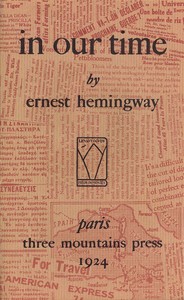
In our time by Ernest Hemingway
Alright, let's talk about this book. It's a bit different from your typical novel. 'In Our Time' is a collection of short stories, mostly about a guy named Nick Adams, with these very short, jarring vignettes about war and violence stuck in between them. We follow Nick from his childhood in the Michigan woods, through his experiences as a soldier in World War I, and into his shaky attempts at a normal life afterward. The stories don't connect in a neat plot line. Instead, they feel like pieces of a life—some quiet and reflective, others sudden and brutal.
The Story
There isn't one plot. Think of it as a photo album of a damaged soul. You see Nick as a kid learning about birth and death on an Indian reservation. You jump to him as a soldier, shell-shocked and disconnected in 'A Way You'll Never Be.' Then he's back home, trying to fish or camp, but the peace won't come. The famous 'Big Two-Hearted River' story is just about him setting up camp and fishing, but the tension underneath is so thick you can feel his need to keep his mind from spiraling. The inter-chapters are the gut-punches: quick, awful scenes from war and bullfights that show where the real damage comes from.
Why You Should Read It
This book taught me how much you can say by leaving things out. Hemingway's famous 'iceberg theory' is on full display here. The real story is the seven-eighths of the iceberg you don't see. The dialogue is sparse. The emotions are held tight. You have to lean in and read between the lines to feel the fear, the trauma, and the quiet desperation. It's not a happy read, but it's a powerful one. It captures the feeling of a generation that went through hell and came back to a world that didn't understand them. It's about the silence that grows between people and the things we carry that we can't talk about.
Final Verdict
This isn't a book for someone who wants a fast-paced, plot-driven adventure. It's for the reader who doesn't mind a little work, who enjoys unpacking a sentence to find the whole world inside it. It's perfect for anyone interested in the 'Lost Generation,' in minimalist writing, or in stories about the psychological aftermath of war. If you've ever felt out of step with the world, Nick Adams might just feel like a strangely familiar friend. Give it a slow, thoughtful read. It's short, but it's heavy.
This publication is available for unrestricted use. Access is open to everyone around the world.
Robert Scott
1 year agoThis book was worth my time since it challenges the reader's perspective in an intellectual way. I will read more from this author.
Emily Perez
2 years agoI've gone through the entire material twice now, and the author manages to bridge the gap between theory and practice effectively. A rare gem in a sea of mediocre content.