
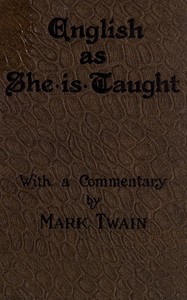
English as She is Taught by Caroline B. Le Row and Mark Twain
So, here's how this weird little book came to be. In 1887, a teacher named Caroline Le Row published a pamphlet called English as She is Taught. It wasn't a textbook. It was a compilation of the most gloriously incorrect answers her students had given on exams. Think of it as the 19th-century version of those 'Kids Say the Darndest Things' segments.
The Story
There isn't a plot in the traditional sense. The first half is just list after list of these student answers. They define an apostle as 'a man sent to preach to the Gentiles' but also 'the man who goes up in a balloon.' They explain that the 'Four Seasons' are 'Salt, Pepper, Mustard, and Vinegar.' They confidently state that 'Magna Charta' was a 'ship that brought over the Pilgrims.' It's pure, unadulterated comedy gold, born from total confusion.
Then, Mark Twain gets his hands on it. He's so tickled that he writes a long, funny essay using Le Row's collection as Exhibit A. His piece, also titled English as She is Taught, is the second half of this book. He doesn't just laugh at the kids; he gets furious at the awful 'parrot system' of education that forced them to memorize nonsense they couldn't possibly understand. He argues the children's honest, creative wrong answers are more logical than the rote memorization they were subjected to.
Why You Should Read It
First, it's genuinely, laugh-until-you-cry funny. The kid logic is timeless. But Twain's commentary is what elevates it. He turns a joke into a serious critique. You realize he's not mocking the children; he's defending them. He's pointing out that when education fails to connect with a student's mind, you get answers that are bizarrely literal or wildly inventive. It's a short, powerful rant against bad teaching that still feels relevant today. Every time a student today mixes up historical facts or mishears a lyric, they're channeling the spirit of this 1887 classroom.
Final Verdict
This is a perfect book for anyone who loves Mark Twain's humor, for teachers who need a reminder to make lessons stick, or for anyone who just wants a guaranteed good laugh. It's a historical curiosity, a comedy routine, and a piece of educational philosophy all wrapped into one quick, delightful package. Don't go in expecting a novel. Go in expecting to underline hilarious lines and think, 'Yep, the system's been broken for a long, long time.'
This book is widely considered to be in the public domain. It serves as a testament to our shared literary heritage.
Elizabeth King
1 year agoFrom the very first page, it manages to explain difficult concepts in plain English. Thanks for sharing this review.
Ashley Miller
9 months agoBased on the summary, I decided to read it and the emotional weight of the story is balanced perfectly. Don't hesitate to start reading.
Donna Jackson
1 year agoBeautifully written.
Barbara Clark
1 year agoI stumbled upon this title and the arguments are well-supported by credible references. Exactly what I needed.




Oliver White
8 months agoI was skeptical at first, but the narrative structure is incredibly compelling. I learned so much from this.