1

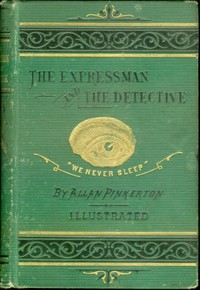
The Expressman and the Detective — Key Ideas to Explore
1437
1
Project Gutenberg
2007
Pinkerton, Allan, 1819-1884; Detectives -- United States -- Biography; Robbery -- United States -- Case studies
Readers of public-domain and historical texts
Project Gutenberg digital edition
en
Edition facts
Words: 77,875
Reading time: 339 min
Text sections: 8
Source:
Project Gutenberg record #22155
Allan Pinkerton's 1874 memoir recounts the investigation of a $37,000 express robbery, focusing on undercover operatives, coded correspondence, and the gradual entrapment of suspects within a jail setting.
Editorial Edition Score
4.7/5
★★★★★
★★★★★
Calculated from edition completeness, EPUB availability, text structure and catalogue metadata. Not a user rating.
Edition quality
Allan Pinkerton opens his 1874 memoir with a direct claim: the story is "true," transcribed from office records, with only "slight" embellishment. This assertion frames the narrative as documentary rather than invention. The preface and publisher's notice position the book as the first in a series of "thrilling and beautifully written Detective Stories," yet the prose that follows is notably plain, favoring procedural detail over dramatic flourish. The account of the robbery investigation unfolds through a sequence of practical maneuvers—arranging ciphers, hiring a "one-horse lawyer," and orchestrating a staged arrest—rather than through suspenseful set pieces. Pinkerton's voice is that of a manager reporting operations, not a storyteller crafting scenes.
The Language of Undercover Work
Pinkerton's narrative voice is remarkably flat and procedural. He describes the preparation of operative Bangs with the same matter-of-fact tone he uses for the jail's class system: "Bangs arranged a cipher for him, to be used in his correspondence, and he learned it thoroughly, so as not to need a key." The emphasis is on systems—codes, messages, and intermediaries—rather than on psychological depth. The undercover agent Shanks becomes a "medium of communication," a functional role rather than a character. This technical language extends to the jail hierarchy, where prisoners are sorted into "first, second, or third-class" based on their ability to pay for meals. Pinkerton reports these details without commentary, letting the institutional logic speak for itself. The effect is a narrative that reads like an operational manual, where human motives are secondary to method.
Pace and the Slow Unfolding of a Sting
The pacing in the excerpt is deliberate and unhurried, mirroring the real-time duration of the investigation. Pinkerton devotes paragraphs to the mundane process of finding a suspect: the Marshal "searched the hotels, saloons, lawyers' offices, etc., going up to the different places, peeping in, and then going off on not finding him." The repetition of actions—"peeping in," "going off"—creates a rhythm of false starts. Once White is jailed, the narrative slows further, tracking daily routines: "Maroney gradually became quite familiar with White. He would bid him good morning when they were released from their cells, and take an occasional turn in the hall with him." The gradualness is the point; Pinkerton documents the erosion of suspicion through routine contact. The pace is not a flaw but a deliberate reflection of investigative patience.
Setting as a Mechanism of Control
The Eldridge Street jail is not merely a backdrop but an active component of the operation. Pinkerton describes its internal economy in precise terms: first-class prisoners could "send out to the neighboring restaurants and order in their meals," while the jailer received a "usual douceur" for introductions. The jail becomes a controlled environment where the detective can manipulate social dynamics. Shanks, the undercover nephew, quickly becomes "such a favorite with the prisoners that he greatly reduced the perquisites of the jailor," indicating a subtle transfer of influence. The setting is a stage where every detail—the cell assignment, the meal orders, the visiting hours—is orchestrated. Pinkerton's attention to these mechanics reveals his understanding of confinement as a tool for observation and entrapment.
Readers approaching The Expressman and the Detective should expect a narrative that prioritizes process over plot. Pinkerton's method is cumulative: small actions—a cipher learned, a message carried, a morning greeting—build toward a resolution that is never dramatized in the excerpt. The book rewards attention to operational detail rather than emotional engagement. Those interested in the mechanics of nineteenth-century detective work will find a meticulous record; those seeking a thriller may need to adjust expectations.
Reader reflection
What was your reading experience?
Capture what you thought, learned, and would like to remember.
Your progress
0
/
10
2
How did the book work for you overall?
3
Would you pass this book on to a friend?
4
Did the language feel accessible?
5
How strongly did the book affect you emotionally?
6
Which part made the strongest impression?
7
Did it raise ideas you would like to talk about?
8
Was the book what you thought it would be?
9
What is the main idea you are taking away?
10