
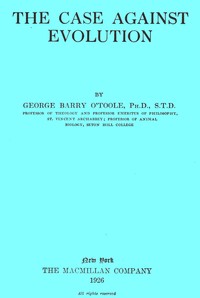
The case against evolution by George Barry O'Toole
George Barry O'Toole's 'The Case Against Evolution' isn't a story with characters and a plot in the traditional sense. Instead, the 'story' is the argument itself. Published in 1925, the book arrives at the peak of cultural tension around evolution, famously highlighted by the Scopes 'Monkey Trial' that same year. O'Toole, writing from his perspective as a Catholic priest and academic, constructs a meticulous case. He walks through the core tenets of Darwinian theory and then, piece by piece, attempts to dismantle them. He questions the fossil record, challenges the idea of natural selection as a sufficient creative force, and argues from philosophical grounds about the need for an intelligent designer. The narrative is the progression of his logic, building what he believes is an irrefutable counter-narrative to the scientific consensus of his time.
Why You Should Read It
You should read this not to be convinced, but to be challenged in a different way. It's a masterclass in seeing how a brilliant, educated mind from another time grappled with a world-changing idea. The value isn't in its scientific accuracy—much of it has been utterly superseded—but in its historical and rhetorical power. It forces you to understand the emotional and intellectual weight of the evolution debate, which can get lost in today's simplified soundbites. Reading O'Toole's passionate, sometimes dense prose, you feel the high stakes he believed were on the table: nothing less than the meaning of human existence and our place in the universe.
Final Verdict
This book is a niche pick, but a rewarding one. It's perfect for history buffs, philosophy students, or anyone deeply interested in the science-religion dialogue. It's also great for readers who enjoy primary sources and want to engage with history directly, not just read about it. I wouldn't recommend it as an introduction to the topic, as it assumes some familiarity with the basic debate. But if you're looking to add depth and historical context to your understanding of one of modernity's biggest ideas, picking up O'Toole's case is like sitting in on a lecture from a forgotten, formidable opponent. Just be ready to think, and maybe to Google a few outdated scientific terms.
This content is free to share and distribute. You can copy, modify, and distribute it freely.
George Thompson
4 months agoI stumbled upon this title during my weekend research and the transition between theoretical knowledge and practical application is seamless. A rare gem in a sea of mediocre content.
William Anderson
3 months agoUnlike many other resources I've purchased before, the formatting on mobile devices is surprisingly crisp and clear. Finally, a source that prioritizes accuracy over hype.
Nancy Garcia
1 year agoMy first impression was quite positive because the clarity of the writing makes even the most dense sections readable. A mandatory read for anyone in this industry.
Melissa Sanchez
1 year agoAfter hearing about this author multiple times, the storytelling feels authentic and emotionally grounded. One of the best books I've read this year.

Robert Thompson
7 months agoRight from the opening paragraph, the data points used to support the main thesis are quite robust. I feel much more confident in my knowledge after finishing this.