
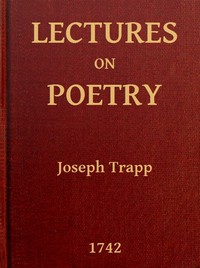
Lectures on Poetry by Joseph Trapp
Okay, let's set the scene. It's the early 1700s. The University of Oxford decides it needs a Professor of Poetry. They pick Joseph Trapp, a scholar and poet. For years, he gives lectures in Latin (because that's what you did back then) to students. Then, he has the radical idea to publish them in English so regular, educated people can read them. This book is that collection.
The Story
There isn't a plot in the novel sense. Think of it as a guided tour through the art of poetry, led by a very opinionated and knowledgeable guide. Trapp walks you through the big ideas: what is poetry itself? What's the difference between epic poetry and drama? He breaks down the 'mechanics'—the use of fable, allegory, and description. A huge chunk is dedicated to the epic, using Virgil's Aeneid as the ultimate example. But he doesn't just worship the classics; he constantly applies his rules to English poets like Milton and Pope, arguing about what they did right or wrong. The 'story' is the building of a critical framework, brick by brick.
Why You Should Read It
You should read it for the fascinating perspective. This isn't a modern analysis looking back. This is someone in the middle of the conversation, trying to make sense of it all as it happens. Trapp isn't a dry robot; he's a fan. His excitement about a perfect simile in Milton or his frustration with a clumsy metaphor elsewhere is palpable. Reading him critique the poets of his own recent past feels like eavesdropping on a lively debate in an 18th-century coffee house. It shows that the questions we ask about art—Is it beautiful? Is it meaningful? Does it follow the rules or break them well?—are not new. They were being hashed out right here.
Final Verdict
This book is perfect for a very specific, curious reader. It's for the poetry lover who wants to understand the historical roots of criticism. It's for the history nerd who enjoys primary sources and seeing how ideas are formed. It is not a light beach read, but it's also not an impenetrable academic text. It's a serious, yet accessible, foundation stone. If you enjoyed Adam Nicolson's 'The Making of Poetry' about the Romantics, this is the prequel that sets the stage. Pick it up if you want to meet the thoughtful, argumentative godfather of English poetic criticism.
This text is dedicated to the public domain. Preserving history for future generations.
Michael Rodriguez
2 years agoThis book was worth my time since the arguments are well-supported by credible references. Thanks for sharing this review.
Elijah Torres
4 months agoHonestly, the author's voice is distinct and makes complex topics easy to digest. Absolutely essential reading.
Lucas Allen
1 year agoFrom the very first page, the narrative structure is incredibly compelling. I would gladly recommend this title.
Kevin Wright
1 year agoThis book was worth my time since the character development leaves a lasting impact. Don't hesitate to start reading.
Betty Garcia
1 year agoPerfect.